
New Publication in ACS Omega on Biobased Benzoxazine Materials
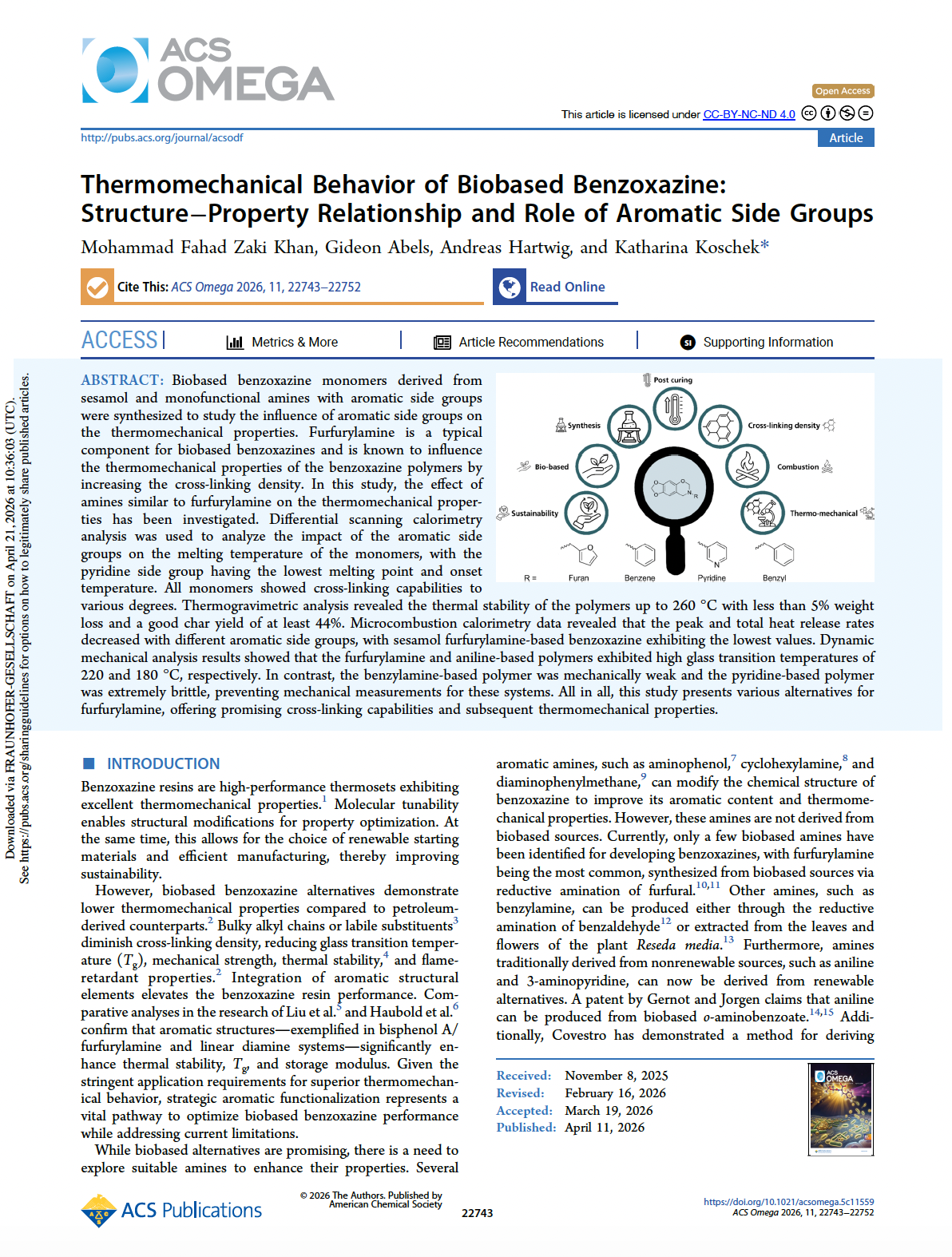
We are pleased to share a new peer-reviewed publication from the FOREST project, titled “Thermomechanical Behavior of Biobased Benzoxazine: Structure–Property Relationship and Role of Aromatic Side Groups”, published in ACS Omega.
The study, led by researchers from the Fraunhofer Institute for Manufacturing Technology and Advanced Materials (IFAM), explores how the molecular structure of biobased benzoxazine resins influences their thermomechanical performance. By combining renewable raw materials such as sesamol with different amine-based components, the research systematically evaluates how various aromatic side groups affect properties such as thermal stability, cross-linking density, and mechanical strength.
The results show that the choice of molecular structure plays a crucial role in material performance. In particular, furan-based systems demonstrated outstanding properties, including significantly higher stiffness and improved thermal resistance, while benzene- and pyridine-based systems also showed strong cross-linking and stability. In contrast, benzylamine-based materials exhibited lower performance due to reduced network formation.
Importantly, the research highlights how targeted molecular design can enhance the performance of bio-based polymers, helping bridge the gap between sustainability and high-performance materials. By establishing clear structure–property relationships, the study provides a valuable framework for developing next-generation thermoset materials for lightweight and energy-efficient applications.
This publication marks another important step in the FOREST project’s efforts to advance sustainable materials and support the transition toward circular and low-carbon industrial solutions.